Welcome to
the Liquid Biopsy Unit
An initiative of the RI-MUHC Cancer Research Program

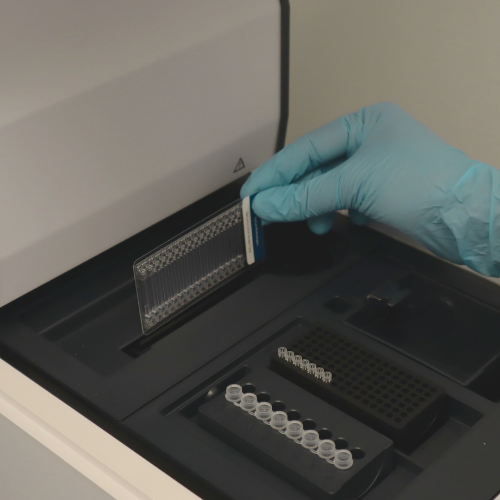
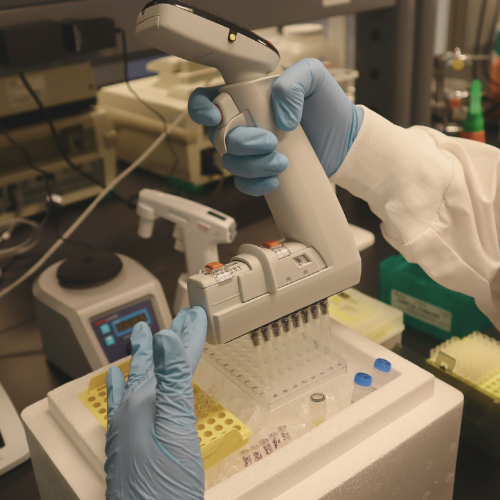
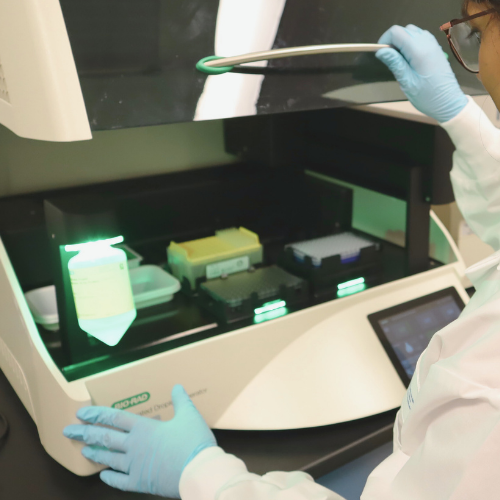
The Liquid Biopsy Unit (LBU) is a collaborative, translational research unit aimed at accelerating the discovery, validation and implementation of circulating free nucleic acid (cfDNA/RNA) cancer biomarkers into clinical workflows
WHAT WE OFFER
We support liquid biopsy projects
through their entire life cycle

Project ideation and brainstorming

Support with grant writing, revision, letters of support, and REB

Assay development and troubleshooting including cfDNA isolation and QC, NGS and ddPCR

Access to biobank of clinical samples
We use our validated systems
We have a repertoire of standard operating procedures (SOPs) and assays.
They allow for:
- Reagent selection for ctDNA quantification by ddPCR
- Cell-free DNA extraction (manual vs. automated)
- Quality control of extracted nucleic acids (% of cfDNA vs. genomic DNA)
- ddPCR validation assays (LoB/LoD/LoQ)
- cfDNA library preparation (targeted and WGS)
- ctDNA analyses mutations and fragmentomic signatures
Our primer/probe/gBlock reagent bank helps detect 90+ single nucleotide variants (SNV’s) in 50+ cancer-related and 25+ viral genes.
We troubleshoot assay development
Our troubleshooting resource helps overcome challenges with ddPCR assays:
- Probe cross-reactivity
- Probe with low separation with baseline negative signal
- Multiplex assay (amplitude based)-targets with varying baseline amplitudes
- Multiplex assay (amplitude based)- insufficient separation between target amplitudes
- Multiplex assay (channel based)- target signal cross-reactivity
- Contamination in NTC wells
We help across cancer types
The LBU has developed several key partnerships with suppliers and service providers,
allowing for discounted reagent/consumable rates and quicker turnaround times.

Comparing liquid biopsy-based bronchoscopic methods to traditional ctDNA methods in suspected metastatic non-small cell lung cancer patients

Monitoring cfDNA and ctDNA in pancreatic patients enrolled in a pre-habilitation program to assess disease burden, survival outcomes and health-related quality of life

Profiling the microbiome, immune cell and lipid diversity in prostate cancer patients

Detecting melanoma returning early by developing a new blood test to track treatment success
WHO IS BEHIND THE UNIT
Meet the team

Julia Burnier, PhD
Lead
Julia leads the direction of the LBU. She completed a PhD in molecular and cell biology at McGill University, focusing on the molecular mechanisms of cancer invasion and metastasis. She then undertook postdoctoral training at McGill and the Centre for Genomic Regulation in Barcelona. Her later work concentrated on cancer genomics in clinical trials at Princess Margaret Hospital in Toronto. In 2018, she launched an independent research program within the Cancer Research Program at the RI-MUHC to study tumor-derived circulating molecules in cancer progression and metastasis. Her research uses liquid biopsies and cell models to develop sensitive biomarkers and targeted therapies by investigating circulating nucleic acids and extracellular vesicles that reprogram the tumor microenvironment.

Shivshankari Rajkumar, PhD
Manager
Shivsha manages the scientific operations of the LBU. Prior to joining the LBU, she was a Senior Research Scientist at a Montreal-based biotech startup developing point-of-need and point-of-care detection and diagnostic technologies, where she led research projects, secured funding, and trained junior scientists. In that role, she also developed a novel, third-party-benchmarked method for shellfish sample processing and marine biotoxin quantification. Shivsha is a biochemist with over seven years of experience in molecular biology, cancer biology, and translational research. Her PhD research at McGill University identified an FDA-approved therapeutic strategy with potential application for melanoma patients carrying co-occurring oncogene and tumour suppressor mutations.
Two committees support the Unit
When collaborating with us, you draw on the strength of expert scientists who align our initiatives with diverse research priorities.
Working Group
A core interdisciplinary group of basic and clinician-scientists with a breadth of expertise that include functional genomics, biomarker discovery and precision medicine. This group was developed to provide ground-floor brainstorming on current collaborative projects, share insights on project design and efficient workflows, and plan for sustained funding.

Annie Leung, MD

Ian Watson, PhD

Patricia Tonin, PhD

Nader Sadeghi, MD

Joanna Przybyl, PhD
Research Advisory Consortium
A consortium of 25+ researchers, clinicians, and senior leadership from RI-MUHC and other institutes helps guide the LBU’s strategic direction, ensure broad engagement among research groups and integrate diverse research priorities. This consortium stays abreast of current collaborative projects and their impact, develops strategies to accelerate liquid biopsy research within the CRP and beyond, and identifies opportunities to integrate workflows across the RI-MUHC.
Patricia Tonin, PhD
Joanna Przybyl, PhD
Nader Sadeghi, MD
Annie Leung, MD
Ramy Saleh, MD, MSc, FRCPC
Antonio Vigano, MD, MSc
Louise Pilote, MD, MPH, PhD
Sushmita Pamidi, MD
David Buckeridge, MD, PhD
Angela Genge, BSc, MD, FRCPC
Ciriaco Piccirillo, PhD
Donald Van Meyel, PhD
Annette Majnemer, OT, MSc, PhD
Simone Chevalier, PhD
Xing Zeng, MD
Victoria Mandilaras, MD
Andrew Zakhari, MD, FRCSC, MGSC
Fadi Brimo, MD
Tarek Hijal MD, CM, MSc, FRCPC
Sarkis Meterissian, MD, MSc, FRCS, FACS
Mariane Bertagnolli, PhD
Ian Watson, PhD
John Stagg, PhD
Simon F Roy, MD, MHS
Ioannis Ragoussis, PhD
Yasser Riazalhousseini, PhD
Mark Basik, MD, CM
Anne-Marie Mes-Masson, PhD, FCAHS, FRSC
Lili-Naz Hazradi, MD, PhD, FRCPC
Get in touch
Interested in collaborating?
We can help you explore accelerate your existing projects, or help start up your first liquid biopsy project.
Please fill out the onboarding form so that we can contact you to schedule our first meeting to discuss project details.
Subscribe to our mailing list
We will let you know of updates related to the LBU.